Afghan Civil Society Organisations Call for the Immediate Release of Six Employees of WCLRF Detained by the Taliban Intelligence

Six senior members of the Women and Children Legal Research Foundation (WCLRF), who were detained by the Taliban intelligence on 18 July 2026 in Kabul, were held for weeks in an “unknown” location, and reports now indicate that their case has been referred to a military court.The undersigned Afghan civil society organisations express deep concern and call for their immediate and unconditional release, as well as an end to the arbitrary detention of human rights defenders, journalists, and civil society workers.On 21 June 2026, Taliban intelligence forces entered the WCLRF office in Kabul, confiscated the phones and laptops of staff members, searched and sealed the office, and interrogated staff about the organisation’s activities, including its online education programme for girls, women’s rights activities, human rights research and reporting, and communications with international organisations.On 18 July 2026, six senior members of the organisation were detained after being summoned under the pretext of collecting the confiscated equipment and were transferred to an unknown location.For approximately one month, their families had no information about their place of detention, health condition, or the charges against them—a situation that, under international law, constitutes enforced disappearance.Only last week was it established that they were being held at Taliban Intelligence Directorate 40, and some family members have been able to meet with them.Reports now indicate that the case of these individuals has been referred to a military court. The alleged charges reportedly relate to activities such as providing online education to girls and producing investigative reports—activities that are entirely peaceful and aimed at supporting the rights of women and girls.This Case Is Not an Exception, the case of the WCLRF employees is part of a broader pattern.Human Rights Watch also issued a separate statement on 12 August 2026 concerning the detention of the six WCLRF…

Continue ReadingAfghan Civil Society Organisations Call for the Immediate Release of Six Employees of WCLRF Detained by the Taliban Intelligence

FORUM-ASIA Calls for Global Solidarity to Address Afghanistan’s Human Rights Crisis

On 15th August 2021, the Taliban illegitimately seized control of Afghanistan, following the Western forces’ withdrawal from the country. Five years since their takeover, the Taliban’s oppressive rule continues to be marked by gender-based persecution, widespread violence and discrimination, ethno-religious domination, and systematic repression. Severe restrictions on civil, political, economic, social and cultural rights combined with the Taliban’s failure to address the country’s economic needs and security challenges have further deteriorated the human rights and humanitarian crises in Afghanistan.Taliban’s war on women, minorities, and gross violations of human rights in Afghanistan stem from both extreme ideological interpretations of religion as well as the group’s select political approach towards power centralization, securitization, and social control to continue their oppression in Afghanistan, in a state of absolute impunity.Gender ApartheidThe hallmark of Taliban’s rule has been its erasure of women and girls from public life. Through its various arbitrary edicts, decrees and regulations, the Taliban has established what UN human rights mechanisms have described as an “institutionalised system of discrimination, segregation, disrespect for human dignity and exclusion of women and girls”, a system that can be best described as gender apartheid.Taliban’s so-called Law on the Promotion of Virtue and Prevention of Vice (PVPV), issued in 2024, imposes restrictions on women’s dress and public presence, reinforces requirements concerning male guardianship, and empowers morality officials to impose measures ranging from warnings to detention. Its recent Criminal Procedure Regulations introduced in January 2026 legitimises violence against women. Subsequent measures introduced in May 2026 restricts women’s ability to seek protection from domestic violence and removes minimum age of marriage normalising child marriage while the ban on education for women and girls remain along with other measures that remove women and girls from virtually every sphere of public and private life.Institutionalised Repression and Rule by DecreeThe Taliban has replaced Afghanistan’s system of governance with a…

Continue ReadingFORUM-ASIA Calls for Global Solidarity to Address Afghanistan’s Human Rights Crisis

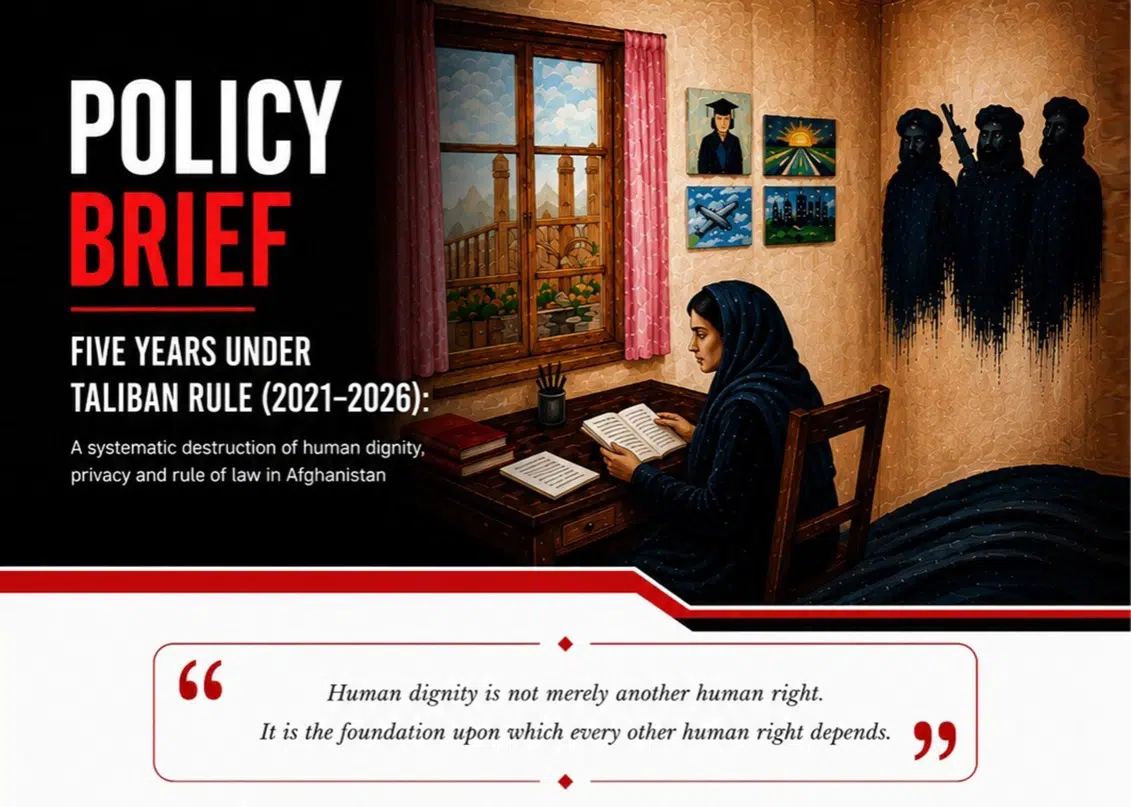
Policy Brief: Five Years Under Taliban Rule (2021-2026)

Five years after the Taliban returned to power on 15 August 2021, Afghanistan has undergone one of the most profound reversals of human rights in its contemporary history. Along with the international community rightly focused on gender apartheid, the exclusion of women and girls from public life, and the collapse of democratic institutions, another dimension of the Taliban's policies needs to be underlined: systematic erosion of human dignity and the right to privacy.Since August 2021, Taliban has issued hundreds of decrees, directives, verbal orders, and administrative instructions affecting nearly every aspect of everyday life. These measures extend far beyond regulating public institutions. They increasingly regulate personal appearance, family relations, education, employment, communication, religious practice, movement, cultural expression, and even activities inside private homes. The cumulative effect is the transformation of Afghanistan into a society governed not merely through law but through pervasive surveillance, fear, and moral control.This report of HRD+ argues that the Taliban's restrictions should not be understood as isolated violations of individual rights. Rather, they constitute an integrated system of governance that progressively dismantles personal autonomy and replaces rights-based governance with ideological control. This governance model undermines the legal protections guaranteed under international human rights law, including the right to privacy under Article 17 of the International Covenant on Civil and Political Rights (ICCPR), and erodes the institutional foundations necessary for justice, economic development, and sustainable peace.Drawing upon a chronology of Taliban decrees and directives issued between August 2021 and June 2026, this report identifies recurring patterns of state intrusion into private life, institutional dismantling, arbitrary punishment, and surveillance. It concludes that the destruction of human dignity is not only a humanitarian concern but also a structural obstacle to Afghanistan's future recovery. Policy Brief - English PDF Policy Brief - Persian PDF

Continue ReadingPolicy Brief: Five Years Under Taliban Rule (2021-2026)

Call for Input from Civil Society Supporting the Operationalization of the Independent Investigative Mechanism for Afghanistan (IIMA)

BackgroundThe establishment of the Independent Investigative Mechanism for Afghanistan (IIMA) by the United Nations Human Rights Council marks a historic milestone in advancing accountability for serious human rights violations and international crimes committed in Afghanistan. This achievement is the direct result of nearly three years of sustained advocacy by Afghan civil society organizations, human rights defenders, and victims’ and survivors’ groups, who have consistently and tirelessly called for the establishment of such a mechanism. Their leadership in this process must be recognized as foundational to the IIMA’s creation and must guide its operationalization.The IIMA has the potential to play a transformative role in preserving evidence, advancing investigations, supporting future criminal proceedings, and contributing to the broader justice agenda for victims and survivors. Its effectiveness, however, will depend not only on its mandate and institutional capacity but also on meaningful and sustained engagement with Afghan civil society, victims, survivors, and documentation initiatives that have worked to document violations under extremely challenging circumstances.Over the past two decades — and particularly since August 2021 — Afghan civil society organizations, human rights defenders, victims’ groups, women’s rights organizations, journalists, and documentation initiatives have gathered invaluable information, preserved evidence, supported victims, and maintained documentation efforts despite significant risks. Their experience and expertise should inform both the establishment and the long-term work of the IIMA.It is important that the relationship between the IIMA and Afghan civil society be reciprocal. While civil society will continue to provide documentation, information, and analysis to support the IIMA’s mandate, the mechanism should also establish meaningful channels for consultation and participation of civil society and victims/survivors regarding its working methods, outreach strategies, priorities, and engagement with affected communities. This engagement should not be ad hoc or occasional; rather, the IIMA should develop a clear, dedicated policy that institutionalizes civil society engagement,…

Continue ReadingCall for Input from Civil Society Supporting the Operationalization of the Independent Investigative Mechanism for Afghanistan (IIMA)

A public call to end Khurram Parvez’ arbitrary detention

(18 June 2026) On his 49th birthday, his fifth while arbitrarily detained, we, the undersigned organisations and individuals, stand in solidarity with human rights defender Khurram Parvez. We demand that the Indian authorities drop all charges against him, release him immediately and unconditionally, and cease their campaign of judicial harassment.We have followed with concern Khurram Parvez’s detention on baseless charges since November 2021, and his continued detention without trial in Delhi’s Rohini Jail. Tomorrow, on his birthday, he will have spent 1,670 days in prison.We remind the Indian authorities that three years ago, in June 2023, the UN Working Group on Arbitrary Detention (UNWGAD) determined that Khurram Parvez’s detention was arbitrary and called on the Indian authorities to release him. We are concerned that the Indian government, despite pledging to participate meaningfully with UN mechanisms as a member of the UN Human Rights Council, has not engaged with the UNWGAD in relation to Khurram’s detention.We recognize that his detention and judicial harassment is happening in a context of longstanding, ongoing grave violations of human rights and fundamental freedoms in Jammu & Kashmir. We strongly condemn the Indian authorities’ widespread and normalized use of repressive counter-terrorism laws, such as the Unlawful Activities (Prevention) Act, under which Khurram Parvez is being targeted, to silence human rights defenders and dissenting voices.We urge the government of India to immediately and unconditionally release Khurram Parvez. We also call on India’s international partners to publicly denounce Khurram Parvez’s detention and to demand that their Indian counterparts release him immediately and unconditionally.We remain steadfast in our solidarity with Khurram Parvez and will continue to call for his release as long as he remains detained. Download English PDF

Continue ReadingA public call to end Khurram Parvez’ arbitrary detention

HRD+ Statement on the Suppression of Protests in Herat and Widespread Human Rights Violations

11.06.2026Human Rights Defenders Plus (HRD+) is following with deep concern the developments of recent days in Herat Province and strongly condemns the violent suppression of protesting citizens, the arbitrary detention of women and girls, and the expansion of intimidation and security restrictions.The public protests in Herat began after Taliban forces detained dozens of women and girls under the pretext of “improper hijab.” This action triggered widespread reactions from citizens, families, civil society activists, and various segments of society. Protesters peacefully took to the streets, calling for respect for human dignity, fundamental freedoms, and an end to arbitrary arrests.According to information collected from local sources, media reports, and eyewitness accounts, Taliban forces used violence, fired warning shots into the air, and in some cases resorted to direct gunfire against demonstrators. As a result of this crackdown, at least three people lost their lives, including a woman, a child, and a man. In addition, approximately 30 citizens were injured, and a number of protesters were arrested.HRD+ is deeply concerned by reports indicating an increase in security pressures across the city of Herat. According to these reports, following the recent protests, the Taliban have:Significantly increased the presence of security forces throughout the city;Initiated house-to-house searches in certain areas;Inspected and monitored citizens’ mobile phones;Exerted pressure on civil society activists, journalists, and social media users;Attempted to prevent the dissemination of images, videos, and information related to the protests. Numerous reports also indicate that a heavy security atmosphere has been imposed on the city. Community elders, influential local figures, and respected leaders in Herat have reportedly come under pressure to refrain from supporting public demands or engaging in independent mediation efforts. This situation has heightened serious concerns regarding freedom of expression, freedom of peaceful assembly, and the security of citizens.We welcome the recent statements issued by…

Continue ReadingHRD+ Statement on the Suppression of Protests in Herat and Widespread Human Rights Violations

HRD+ Statement On the Violent Suppression of Protesters in Herat

09/06/2026Human Rights Defenders Plus (HRD+) strongly condemns the violent and unlawful suppression of women and citizens protesting in the Jebrail area of Herat by Taliban forces.According to reports and published footage, women protesters who had gathered to demonstrate against injustice, the arrest of women, and the increasing restrictions on the fundamental rights and freedoms of citizens were met with gunfire, beatings, and arrests by Taliban forces. This action constitutes not only a blatant violation of fundamental human rights, but also a direct assault on the rights to freedom of expression, freedom of peaceful assembly, and the human dignity of the people of Afghanistan.We are deeply concerned by reports indicating that Taliban forces opened fire on protesters, including women, resulting in injuries to a number of civilians. No government or authority has the right to respond to the legitimate demands of its people with bullets, violence, and intimidation. The violent treatment of women protesters reflects the continuation of a systematic policy of repression that the Taliban have pursued against the rights and freedoms of the people of Afghanistan.HRD+ calls on the Taliban to immediately and unconditionally end the repression of the population, release all individuals detained in connection with these events, cease the use of violence against civilians, and respect the fundamental rights of the people, including the right to peaceful protest, the right to education, the right to work, and the right to participate in social and political life.The Afghan people’s demand for “education, work, and freedom” is a legitimate, humane, and undeniable demand. Suppressing these aspirations will not only deepen the human rights crisis but will further widen the gap between those in power and the people they govern.We also call on the United Nations, international human rights mechanisms, Special Rapporteurs, civil society organizations, and all human…

Continue ReadingHRD+ Statement On the Violent Suppression of Protesters in Herat

HRD+ Statement: Detention of Women and Girls in Herat

7th of June 2026In light of the escalating restrictions against women in Herat Province, multiple reports of the detention of women and girls based on their manner of dress, and the widespread concerns expressed by citizens, educators, and civil society activists regarding the consequences of these measures, Human Rights Defenders Plus (HRD+) once again expresses its deep concern over the state of women’s rights and fundamental freedoms in Afghanistan.Recently, citizens of Herat addressed an open letter to the Governor of Herat, emphasizing the religious, cultural, and historical values of the province while expressing concern about the imposition of extreme restrictions on women and girls. In their letter, they referred to Islamic teachings, including the hadith, “The blood, property, and honour of every Muslim are sacred to another Muslim,” as well as Quranic verses concerning justice, benevolence, and human dignity. They stressed that safeguarding the dignity, reputation, and rights of citizens is among the fundamental responsibilities of those in authority and that any social policy should be based on justice, moderation, respect for human dignity, and consideration of the cultural and historical characteristics of society.The citizens of Herat also expressed concern regarding the compulsory imposition of a specific form of dress on women, the arbitrary enforcement of regulations, the lack of transparency in the implementation of restrictions, and the potential for creating social divisions. They called for any regulations to be applied fairly, transparently, and in accordance with the law throughout the country. They further emphasized that the women of Herat have always been an inseparable part of the province’s cultural, intellectual, and social identity and warned that increasing restrictions could negatively affect their social, educational, economic, and cultural participation.HRD+ is also deeply concerned by reports that announcements issued by the Taliban’s Ministry for the Promotion of Virtue and Prevention of Vice have…

Continue ReadingHRD+ Statement: Detention of Women and Girls in Herat

Open Letter on the Proposed Engagement of Taliban Representatives in Brussels

27 May 2026 To: European Union institutions, Member States, and relevant decision-makers We, the undersigned national and international civil society organisations and human rights defenders, express our grave concerns regarding reports of a possible official visit of representatives of the Taliban to Brussels in June 2026. It is important to recall that the Taliban do not represent the people of Afghanistan, as they lack domestic democratic legitimacy. Their authority has not been established through any participatory, inclusive, representative, or constitutional process. Two senior Taliban leaders are currently subject to arrest warrants issued by the International Criminal Court for the crime against humanity of persecution on gender grounds, and multiple individuals associated with the Taliban remain listed under international sanctions regimes, including those of the European Union.  In this context, any official engagement with Taliban representatives, particularly on European soil, carries significant legal, political, and symbolic implications. It risks being perceived as a form of normalization or implicit recognition. Since August 2021, the Taliban have implemented a wide range of policies, decrees, and institutional measures that have resulted in the systematic dismantling of fundamental rights and freedoms. Women and girls have been almost entirely excluded from public life, including through bans on secondary and higher education, and severe restrictions on employment, freedom of movement, and participation in civic and political spaces. These measures, when viewed collectively, have been assessed, in addition to the International Criminal Court, by various United Nations human rights experts and legal scholars as potentially amounting to gender persecution as a crime against humanity under international law. In addition, there have been consistent reports of serious human rights violations, including: arbitrary detention; enforced disappearance; extrajudicial killings; torture and ill-treatment; and reprisals against human rights defenders, journalists, and former public officials. The lack of transparency and independent monitoring mechanisms makes the full scale of these violations difficult to verify, yet available evidence indicates a deeply concerning and ongoing pattern. What…

Continue ReadingOpen Letter on the Proposed Engagement of Taliban Representatives in Brussels

HRD+ Statement: Is Afghanistan’s Obligations as a Member of the International Community?

Following the publication of a communication by United Nations Special Rapporteurs and senior experts on the situation of human rights in Afghanistan, Human Rights Defenders Plus (HRD+) expresses its strong condemnation and deep concern regarding policies that violate the fundamental rights of citizens, including the endorsement of Taliban Decree No. 12 under the title “Criminal Procedure Code for Courts”This approach towards governance has severely restricted and, in cases, stripped away access to justice and the fundamental rights of citizens in Afghanistan.Afghanistan International ObligationsAs a state, Afghanistan remains a formal member of the international community and is bound by multiple conventions which, under international law, remain in force regardless of changes in government. By acceding to treaties such as the followings, Afghanistan is obligated to uphold global standards:International Covenant on Civil and Political Rights (ICCPR);Convention on the Elimination of All Forms of Discrimination Against Women (CEDAW).Convention Against Torture (CAT).Convention on the Rights of the Child (CRC).Obviously, a meaningful engagement with the world does not come through isolation, but through adherence to these principles and respect for the fundamental rights of citizens.Violation of the Right to Life and Human DignityThe expert analysis by the United Nations demonstrates that Taliban decrees clearly target the right to life (as enshrined in Article 6 of the ICCPR):Unlawful expansion of the death penalty: Issuing death sentences for crimes that do not meet the threshold of “most serious crimes” under international law (such as repeated theft and corruption) constitutes a grave violation of the right to life.Degrading and corporal punishments: Legalizing public flogging and other forms of corporal punishment constitute torture and inhuman treatment, which are absolutely prohibited under the Convention Against Torture.Institutionalised Discrimination and Legal ApartheidThe legislative decrees of the Taliban administration have codified a discriminatory social hierarchy (dividing citizens into classes such as…

Continue ReadingHRD+ Statement: Is Afghanistan’s Obligations as a Member of the International Community?