HRD+ Statement: Is Afghanistan’s Obligations as a Member of the International Community?

Following the publication of a communication by United Nations Special Rapporteurs and senior experts on the situation of human rights in Afghanistan, Human Rights Defenders Plus (HRD+) expresses its strong condemnation and deep concern regarding policies that violate the fundamental rights of citizens, including the endorsement of Taliban Decree No. 12 under the title “Criminal Procedure Code for Courts”This approach towards governance has severely restricted and, in cases, stripped away access to justice and the fundamental rights of citizens in Afghanistan.Afghanistan International ObligationsAs a state, Afghanistan remains a formal member of the international community and is bound by multiple conventions which, under international law, remain in force regardless of changes in government. By acceding to treaties such as the followings, Afghanistan is obligated to uphold global standards:International Covenant on Civil and Political Rights (ICCPR);Convention on the Elimination of All Forms of Discrimination Against Women (CEDAW).Convention Against Torture (CAT).Convention on the Rights of the Child (CRC).Obviously, a meaningful engagement with the world does not come through isolation, but through adherence to these principles and respect for the fundamental rights of citizens.Violation of the Right to Life and Human DignityThe expert analysis by the United Nations demonstrates that Taliban decrees clearly target the right to life (as enshrined in Article 6 of the ICCPR):Unlawful expansion of the death penalty: Issuing death sentences for crimes that do not meet the threshold of “most serious crimes” under international law (such as repeated theft and corruption) constitutes a grave violation of the right to life.Degrading and corporal punishments: Legalizing public flogging and other forms of corporal punishment constitute torture and inhuman treatment, which are absolutely prohibited under the Convention Against Torture.Institutionalised Discrimination and Legal ApartheidThe legislative decrees of the Taliban administration have codified a discriminatory social hierarchy (dividing citizens into classes such as…

Continue ReadingHRD+ Statement: Is Afghanistan’s Obligations as a Member of the International Community?

HRD+ Statement on Killing of Civilians in Herat, Afghanistan

15 April 2026With deep sorrow and grave concern, Human Rights Defenders Plus (HRD+) has received confirmed reports of a deadly incident in Injil District of Herat Province-an incident that once again targeted defenceless civilians and plunged the community into shock and mourning.According to information from local sources and supplementary reports, the incident occurred in the “Deh Mehri” area of Injil District, near “Razshak and Hashemi Bridge,” adjacent to a shrine. Armed unidentified individuals, in broad daylight, opened fire on civilians who had gathered at the shrine area to spend leisure time with their families and children, subjecting them to indiscriminate gunfire.Based on updated figures, 11 people have been killed and 11 others injured as a result of this attack. This crime stands as one of the most devastating attacks against civilians in recent years and has sparked widespread grief and outrage among the public.Following the incident, today thousands of citizens in Herat Province staged large-scale protests, demanding the immediate provision of security, an end to the spread of extremist ideologies, the protection of religious freedoms, and serious reforms in security structures. Protesters also accused responsible authorities of negligence in ensuring security, delays in emergency response, and the absence of effective preventive measures at the time of the incident, calling for independent investigations and accountability for the perpetrators.HRD+ warns that such incidents may have dangerous and long-term consequences, including the deepening of social and religious divisions, increased public distrust, and the weakening of peaceful coexistence within society.Based on preliminary information and available eyewitness evidence, there are multiple indications suggesting that this attack was organised and of a terrorist nature, including:Reports of insults and abusive language directed at the religious beliefs of the Shia community during the commission of this crime;The use of “finishing shots” against some victims with the…

Continue ReadingHRD+ Statement on Killing of Civilians in Herat, Afghanistan

Protect Afghan Civilians: A Plea for Chapter VII Intervention

Afghan civil society is formally urging the UN Security Council to intervene as hostilities between Pakistan and the Taliban regime reach a breaking point. Since February 26, 2026, escalated strikes and clashes across 10 provinces have created a dire humanitarian crisis.The Impact on the Ground:Casualties: At least 289 civilians have been killed or injured, with women and children accounting for half.Displacement: Over 40,000 people have been forced from their homes.Destruction: More than 300 shelters and a drug rehabilitation facility have been destroyed.These actions constitute manifest violations of Article 2(4) of the UN Charter. We request a formal determination under Article 39 and a demand for the immediate cessation of all unlawful cross-border force. The Security Council has a heightened obligation to act when the rights of the Afghan people are being systematically ignored. Download English PDF

Continue ReadingProtect Afghan Civilians: A Plea for Chapter VII Intervention

HRD+ Statement in Support of Freedom of Expression of Civil Activists Advocating for the Fundamental Right to Education

29.03.2026Human Rights Defenders Plus (HRD+) states that Mr. Qadoos Khatibi and Mr. Fayyaz Ghori, civil activists from Herat, have, solely as responsible citizens, expressed their peaceful views in support of reopening schools for girls and have advocated for their right to education. This action represents a clear manifestation of the connection between “freedom of expression” and the “right to education,” both of which are explicitly emphasized in Articles 19 and 26 of the Universal Declaration of Human Rights.By referring to Article 13 of the International Covenant on Economic, Social and Cultural Rights we recall that education serves as a tool for empowering individuals to participate in a free society. Therefore, imposing restrictions on those who advocate for this right constitutes a chain violation of fundamental human rights. No individual should be subjected to pressure or threats for exercising their right to freedom of expression, as stipulated in Article 19 of the International Covenant on Civil and Political Rights.HRD+ calls on the relevant authorities to adhere to their international obligations, to end the harassment, particularly the arrest of activists, and to ensure the immediate reopening of schools and universities for women and girls. Download English PDF Download Persain PDF

Continue ReadingHRD+ Statement in Support of Freedom of Expression of Civil Activists Advocating for the Fundamental Right to Education

Kashmiri journalist and human rights defender Irfan Mehraj held for three-years inpre-trial detention

19 March 2026As journalist and human rights defender Irfan Mehraj marks three years in arbitrary detention tomorrow, we the undersigned civil society organizations call for his immediate and unconditional release. We continue to stand in solidarity with Irfan and his family. Our organisations also demand an end to the Indian government’s continuedrepression of human rights defenders and journalists in Jammu and Kashmir.On 20 March 2023, Irfan Mehraj was detained by India’s National Investigation Agency (NIA) under provisions of the Indian Penal Code and the Unlawful Activities (Prevention) Act (UAPA) on politically motivated and fabricated charges. According to the NIA, Irfan Mehraj was arrested for being ‘a close associate of Khurram Parvez’. Khurram Parvez is a HRD and the Program Coordinator of the Jammu Kashmir Coalition of Civil Society (JKCCS), a leading civil society organisation in Jammu and Kashmir. Indian authorities continue to arbitrarily detain Khurram Parvez for over four years now on politically motivated and fabricated charges.The ongoing detentions of Irfan Mehraj and Khurram Parvez highlight a broader pattern of persecution of human rights defenders and journalists in Jammu and Kashmir.The authorities have used the UAPA – a draconian anti-terror law - and the repressive Jammu and Kashmir Public Safety Act (PSA), which permits long-term detention without trial, to criminalise and silence journalists and human rights defenders in Jammu and Kashmir. This has worsened since the unilateral abrogation of Jammu and Kashmir’s statehood in August 2019.In recent months, the police continued to harass and intimidate journalists from Indian administered Kashmir for their reporting, including through summoning them for repeated police interrogations and demanding that journalists sign a bond undertaking that they will not do anything that would ‘disturb peace’.The Indian government has continuously failed to respond to concerns regarding human rights violations in Kashmir raised by United Nations…

Continue ReadingKashmiri journalist and human rights defender Irfan Mehraj held for three-years inpre-trial detention

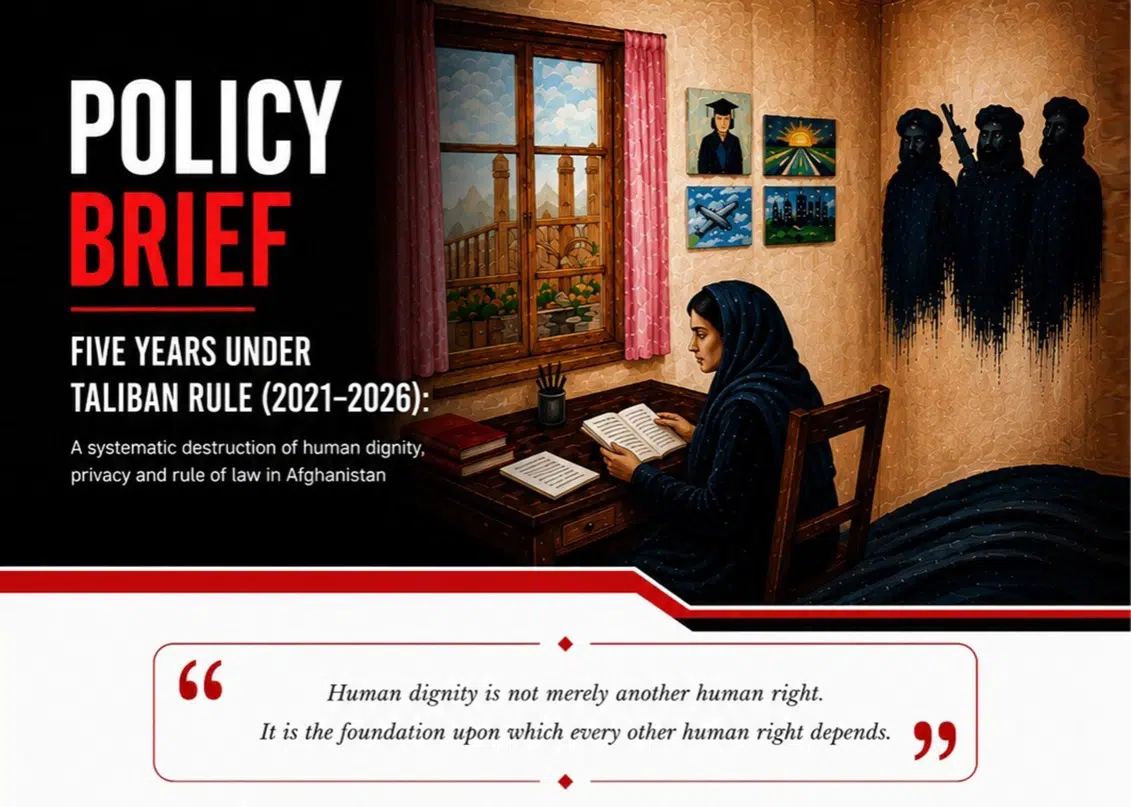
Policy Brief: The Taliban’s Gender Governance Model: Implications and Future Prospects

SummarySince the Taliban’s return to power in August 2021, Afghanistan has witnessed fundamental changes in its political and social structure. One of the most striking features of this period is the issuance of a broad set of decrees and directives that have directly restricted the rights and freedoms of women and girls. An examination of the list of these decrees indicates that Taliban’s actions are not merely ad-hoc or short-term decisions, but part of a it is a ongoing process to redefine the role of women in society and limit their presence in the public sphere.These policies cover various areas of social life, including access to education, economic participation, freedom of movement, media presence, and social participation. Restrictions on girls’ education from secondary to university levels, banning women from working in many government departments and non-governmental organizations, imposing broad restrictions on women’s freedom of movement, and monitoring their social dress and behavior are among the most important of these measures. In addition to these restrictions, the role of the Ministry of Promotion of Virtue and the Prevention of Vice and the implementation of public punishments have also been used as tools for social surveillance and control.An analysis of these policies shows that the Taliban have gradually developed a type of gender governance model that is based on gender segregation, control of social behavior, and limitation of women’s role in the public sphere. In this context, women have been increasingly excluded from the education system, labor market, public spaces, and social decision-making processes.The consequences of these policies are not limited to women’s rights but also have far-reaching implications for Afghanistan’s social and economic development. Reduced women’s access to education can lead to a shortage of skilled manpower in sectors such as education and health in the long run. The…

Continue ReadingPolicy Brief: The Taliban’s Gender Governance Model: Implications and Future Prospects

Joint Statement on the Escalation of Tensions Between Pakistan and de facto authorities in Afghanistan

We are deeply concerned by the rapidly unfolding situation between the Islamic Republic of Pakistan and the de facto authorities in Afghanistan. The escalation of cross-border hostilities in recent weeks has placed civilian lives, regional stability, and long-standing economic ties under grave threat.Over the past weeks, exchanges of military strikes and confrontations have intensified along the shared border, including air operations and ground clashes that both Islamabad and Kabul have described as significant escalations of a conflict that has simmered for years. Pakistan’s defence authorities have described the situation as a state of “open war”, citing repeated cross-border attacks and pledging further operations, and de facto authorities have openly condemned strikes on its cities and border provinces as breaches of sovereignty.Amid this violent escalation, the humanitarian toll has already mounted. UNAMA has documented 146 civilian casualties including the confirmed death of children and women.Afghanistan has endured nearly five decades of war, displacement, forced returns, and recurrent cycles of violence, leaving millions of families vulnerable and economically fragile. The intensifying confrontation threatens to worsen conditions for communities on both sides of the border, including refugee families, internally displaced persons, traders, and labourers whose livelihoods depend on peaceful cross-border economic activity. Restriction of movement and closure of border crossings already undermine trade, access to goods and services, and traditional economic livelihood patterns that have historically supported border-region families.As Iran, Afghanistan’s western neighbour, remains embroiled in conflict, the growing number of people living in poverty is likely to face worsening livelihood scarcity and rising inflation, largely due to the disruption of regional trade. We therefore urge the de facto authorities to immediately ensure secure trade routes, including with Pakistan, to help alleviate the economic hardship faced by the population amid heightened regional tensions, which have left millions of civilians struggling to…

Continue ReadingJoint Statement on the Escalation of Tensions Between Pakistan and de facto authorities in Afghanistan

Civil Society Joint Statement “Criminal Procedure Code for Courts” will further deepen the human rights crisis in Afghanistan

Civil Society joint statement addressing the ongoing and grave human rights concerns in Afghanistan. This statement reflects a collective commitment by civil society partners to uphold fundamental rights, accountability, and justice.We invite our partners, media colleagues, and supporters to read the full statement and share it widely. Broad engagement and coordinated advocacy are essential to amplifying the voices of affected communities and advancing principled international action.We remain committed to continued collaboration in support of the people of Afghanistan. Download English PDF Download Persian PDF Download Pashto PDF

Continue ReadingCivil Society Joint Statement “Criminal Procedure Code for Courts” will further deepen the human rights crisis in Afghanistan

HRD+ Statement on the Destruction of Musical Instruments and the Violation of the Cultural Rights of Citizens of Afghanistan

Human Rights Defenders Plus (HRD+) issues this statement to draw the urgent attention of the international community to the serious and systematic violations of the cultural rights of the citizens of Afghanistan.Based on documented reports and published images, the Taliban have collected musical instruments in the provinces of Parwan and Laghman and publicly set them on fire. The deliberate dissemination of images of this act on social media reflects a targeted approach aimed at suppressing the art of music and creating an atmosphere of intimidation against artists across the country.The public destruction of musical instruments sends a threatening message to artists, musicians, and all individuals whose identity and livelihood are connected to art. When artistic tools are set ablaze, a legitimate and profound concern arises as to what fate may await the human beings who embody that very culture and artistic expression.This act constitutes a clear violation of fundamental cultural rights recognized in authoritative international instruments, including:The Universal Declaration of Human Rights (particularly Article 27)The International Covenant on Civil and Political Rights (particularly Article 19)The International Covenant on Economic, Social and Cultural Rights (particularly Article 15)The right to participate in cultural life, to enjoy the arts, and to access cultural heritage are inalienable rights of all human beings.Moreover, under current policies, art in Afghanistan has effectively been rendered prohibited, and artistic activities under Taliban rule are subject to extensive restrictions. Artists, poets, and cultural actors face systematic exclusion, severe limitations, and security threats. Many remain in precarious and uncertain conditions, seeking safe pathways to continue their lives and professional activities, while their sources of livelihood and professional identity have been severely undermined.We call upon the Special Procedures of the United Nations Human Rights Council, particularly the Special Rapporteurs in the field of cultural rights, and the situation of…

Continue ReadingHRD+ Statement on the Destruction of Musical Instruments and the Violation of the Cultural Rights of Citizens of Afghanistan

A Legal Critique of the Taliban’s Judicial Charter From “Law” to a “Charter of Barbarism” in Afghanistan

Date: 23/01/2026The Taliban have issued on 4th of January 2026 a document entitled “Criminal Procedure Code for Courts” which is claimed to have entered into force and to be binding following its signature by Hibatullah Akhundzada as the Taliban leader. On its face, the document is presented as a framework for regulating the judicial and administrative affairs of the courts. However, a careful examination shows that it is incompatible with the fundamental standards of public law, the principles of fair trial, and the accepted rules of international law. In reality, the main problem with this document is not limited merely to its content, but lies in its legal nature itself; because both formally and substantively, the text lacks the essential elements required to be recognised as a law or a valid legal norm.In the philosophy of law and norm theory, a rule is considered law only when it is produced within a coherent legal system, enjoys social and political legitimacy, is compatible with principles of justice and human dignity, and is expressed through proper legal language and structure. Accordingly, not every signed text or decree issued by a ruling power necessarily creates law; rather, it acquires legal validity only when it embodies fundamental criteria such as clarity, certainty, predictability, general applicability, non-discrimination, proportionality, and accountability. When a document lacks these criteria, at best it is a political directive, and at worst, an instrument for consolidating domination and legitimising structural violence. In other words, such a text does not limit power; instead, it absolutizes power and strips rights of their civilising function.The Taliban’s charter faces a profound crisis precisely at this point. A document intended to regulate the judicial system must clearly define the jurisdiction of courts, procedural principles, the right to defence, standards of proof, judicial independence, mechanisms…

Continue ReadingA Legal Critique of the Taliban’s Judicial Charter From “Law” to a “Charter of Barbarism” in Afghanistan